
MOST READ
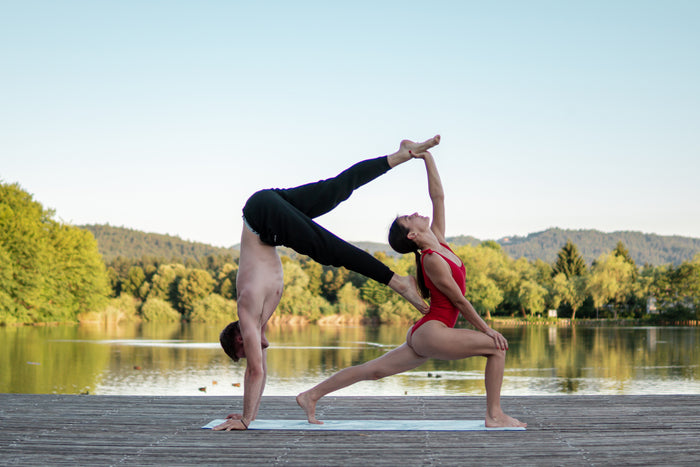
Have you always wanted to fly? In AcroYoga, we connect with each other through movement and play to float together. This form of yoga helps you build trust not only in your own body, but also within your partnership or friendship.
 We've summarized for you what's behind the yoga trend and how you can try it out in your own home.
What is AcroYoga and where does it come from?
AcroYoga is a form of partner yoga. The term was first used in Canada in 1999 by Eugene Poku and Jessie Goldberg. The two began their journey together in dance and then revised their routine to incorporate acrobatics and yoga.
In 2003, AcroYoga International was finally founded in San Francisco by Jason Nemer and Jenny Sauer-Klein. They coined the AcroYoga terminology used today and developed a training program that enables teachers worldwide to teach.
AcroYoga combines traditional Hatha or Vinyasa Flow yoga with acrobatics. It can also incorporate elements of healing arts such as Thai massage. Gravity is used both to strengthen and stretch muscles.
A typical AcroYoga session consists of warm-up, partner work, flowing sequences, inversions and can be rounded off with a Thai yoga massage.
Do I need any prior acrobatic experience?

No. You don't need to be a champion gymnast or a circus acrobat to start AcroYoga. Just like with solo yoga practice, it's more about listening to your body and exploring its natural range of motion. Gradually, you'll learn movement patterns and skills that will literally take you to the next level.
All you need is your own motivation and a partner with whom you can test the laws of gravity together.
Yoga exercises for two for more mindfulness
While solo yoga and meditation often involve spending a lot of time in your head, AcroYoga is an intensive partner activity that creates a shared physical experience for you and your fellow yogi. You not only learn to perceive points of contact more consciously, but also further develop your communication skills.
AcroYoga is a way to interact with your partner, listen attentively, and communicate your own needs.
You might already be familiar with the basics of mindfulness from our article " Mindfulness as a way to combat the winter blues." While inward-focused mindfulness primarily involves communicating with yourself, AcroYoga offers a way to interact with your partner, listen to them, and communicate your own needs.
Flying Yogis – Terms in AcroYoga

Are you a base, a flyer, or both?
To facilitate communication, there are a few basic terms that every Acro-Yogi should know. Good communication is important to ensure safety and to get into a flow together.
You will hear the following terms during an AcroYoga class:
Base: As the name suggests, the base is the person on the ground. In most poses, they lie with their back firmly on the mat. Your role as the base is to provide a stable foundation for the AcroYoga poses of the flyer.
Flyer: The flyer, or flyer, is the person who is lifted from the base. Body tension and balance are essential skills for the flyer. Once airborne, the flyer assumes poses similar to yoga asanas.
Spotter: The spotter acts as a mediator between the base and the flyer. They offer support and help improve pose form and ensure the safety of all practitioners.
Solar Acrobatics: In this dynamic part of AcroYoga, the focus is on the flow of movement. Base and flyer are in constant motion, flowing from one pose to the next. This even includes jumps and turns.
Lunar Acrobatics. This gentler form of AcroYoga is also known as therapeutic flying. The flyer is positioned in static postures similar to asanas in Hatha Yoga. The focus is on relaxation. The flyer is lifted from the base, moved, and sometimes massaged.
Yoga: As a counterpart to the physical element of acrobatics, yoga brings spirituality and creates harmony between body and mind. Pranayama breathing techniques and mindful movements by both partners promote this physical and mental connection.
If the communication is good, you'll learn AcroYoga in a playful way with your partner. And along the way, you'll also discover some interesting things about yourself.
3 things AcroYoga teaches you

AcroYoga looks beautiful, feels good, and allows for new perspectives on one's own abilities. It's an invitation to see yourself and your partner from an authentic point of view.
1. Open communication: the key to successful teamwork
Communication is key to successful teamwork. Exercises often become chaotic when there are misunderstandings. You'll find a shared flow, however, when there's open and trusting communication – whether verbal, through eye contact, or touch. You and your partner decide how you can best communicate mindfully.
2. Honest self-assessment of natural limits
Balancing someone above your head only works if you have the correct posture. This means your body has to be ready. AcroYoga allows you to realistically assess your physical abilities, by acknowledging the natural limits your body sets.
3. Natural flow: synchronized with the partner
Getting into a flow requires timing. By working through a new pose with your partner, you learn to adjust your pace to theirs to become synchronized. Once your bodies are in flow, you're ready for the next level. Gradually, you can reduce contact points and minimize movements.
AcroYoga exercises for beginners at home
Although there is now a worldwide community that regularly holds so-called AcroYoga jam sessions .
Good beginner poses are Throne, Free Bird, and Folded Leaf. Use a photo guide for the five best beginner exercises or a video tutorial for AcroYoga newbies: https://www.youtube.com/watch?v=nyzd9kPnPSw (AcroYoga for Beginners at Home)
It's important that you have enough space and start with beginner-level exercises to prevent injuries. If you respect your physical limits, AcroYoga is quite safe and, above all, a lot of fun.
Take off together

AcroYoga not only gives you a comprehensive workout for body and mind, but also promotes strength, balance, flexibility, and coordination. You learn more about your own gravity and discover what it means to be in flow with your partner.
Interacting with other yogis also gives you the opportunity to view your own body from a new perspective. And what could be better than truly feeling yourself and your partner? So grab your partner or a friend and take off together…
And don't forget your LUVIYO!
Deine Reise geht weiter...
WEITER LESEN
ALLE LESEN Yoga
Yoga
Breathwork: How just a few minutes of conscious breathing a day can change your life
The hype surrounding breathwork Breathing exercises (or 'breathwork') are all the rage. Working with your own breath is so simple, yet it's one of the most effective tools for combating stress. When you talk to wellness experts about relaxation, you inevitably come across breathwork. For example, breathwork teacher and freediver...
Read Now
 Road
Road
Franzisca's path to resilience through cold water therapy and breathing exercises
Introduction In our latest episode of Road to Calm, we had the honor of interviewing Franzisca Gartenmann, co-founder of Keen Wellbeing. She shares her personal journey through burnout and trauma to a fulfilling life as an entrepreneur. 🌟 Franzisca talks about the benefits of cold water therapy, sauna, and breathing...
Read Now
 Road
Road
A journey through Katonah Yoga and personal growth
A journey through Katonah Yoga and personal growth In today's episode of the "Road to Calm Podcast," we speak with Aylin Karadayi, an inspiring Katonah Yoga teacher, former nutritionist, and experienced entrepreneur. She recently opened her latest project, the Yoga & Wellbeing Studio VVOO, in Zurich. Aylin shares her profound...
Read Now
 Yoga
Yoga
15-Minute Yoga Challenge
15-Minute Yoga Challenge – Find inner balance in one month Most of us try to be just as productive and active throughout the winter as we are in the summer. If we don't manage this, we quickly start berating ourselves, especially after the first few weeks of the new year,...
Read Now
#luviyofamily
We are social 💗
Follow us @luviyo and join our family!
Loved by Peter and many more...