
MOST READ
 Anyone who can breathe can practice yoga.
This quote from the yogi Krishnamacharya aptly describes the philosophy of yoga. For it is neither a competitive sport nor a religion. Yoga is a kind of worldview.
Conscious breathing is an integral part of yoga. And that's precisely what might catch your attention when you see what some yogis are capable of after years of training: exercises like the scorpion pose performed in a handstand are good examples of this.
But don't let that intimidate you, because yoga is not just a physical practice, but also a mental one. You'll benefit from many exercises right from your first yoga class – regardless of your physical condition. The most important thing is that you breathe freely and without restriction.
You can adapt the various exercises (asanas) to your individual physical abilities. Of course, there are also sequences of movements that look incredibly acrobatic and seem unattainable for beginners. But yoga isn't about extreme poses. Strength and flexibility can certainly be goals for you – but the heart of yoga lies in performing the exercises with the correct awareness and breathing.

If you're just starting out, the simplest exercises are best. You can make more challenging stretches easier with aids like a yoga block .
Below you will learn how beginners and advanced practitioners differ in yoga and which are the most well-known yoga exercises for each level.
How do the levels in yoga differ?
There's no such thing as a black belt for yogis. It's more about the experience you've gained with the individual exercises – and that you perform them correctly. Especially at the beginning of your yoga practice, you'll only be able to do many asanas in their gentler versions – which is perfectly fine.
Yoga teaches you to listen to your body. As your practice progresses, you will become increasingly flexible. Eventually, you will be able to perform exercises that you couldn't do at the beginning in their perfected form.
Then, for example, you'll be able to do downward-facing dog with straight knees, stretched shoulders, and both heels on the ground almost effortlessly. We'll explain this exercise in more detail below – including a beginner's version.
The 15 most well-known yoga poses

Yoga offers countless poses. The most well-known is certainly the sun salutation. It consists of a sequence of eight individual exercises, some of which are repeated.
The sun salutation is a fantastic warm-up exercise for all levels. Advanced practitioners perform more intense stretches during the exercises or incorporate dynamic jumps into the transitions.
At first, you should approach the sun salutation gently and pay attention to the correct execution of each part. Whenever the stretch becomes too intense, you can keep your knees slightly bent. You can watch the exercise step-by-step for beginners in the video.
Here is the sequence of the sun salutation:
For beginners: Bend forward only as far as you comfortably can. Possible goal: Flexible professionals can achieve a jackknife-like posture during this exercise.
4. Sprinter
5. Push-ups
7. The Cobra
For beginners: The Cobra pose replaces the Upward-Facing Dog exercise in its beginner variation. You lie down on the floor and then stretch your upper body upwards. In an even gentler version, you can also rest your elbows on the floor.

8. Upward-Facing Dog .
Note: In this exercise, you do not lower your body after the push-up, but hold it in the air and stretch your upper body far back.
For beginners and advanced practitioners: Especially at the beginning, you can keep your knees slightly bent during this exercise. In the advanced version, your heels are firmly on the ground and your arms and legs are fully extended. From the side, yoga professionals look like a pointed triangle in this position.
Other well-known yoga exercises – also suitable for beginners
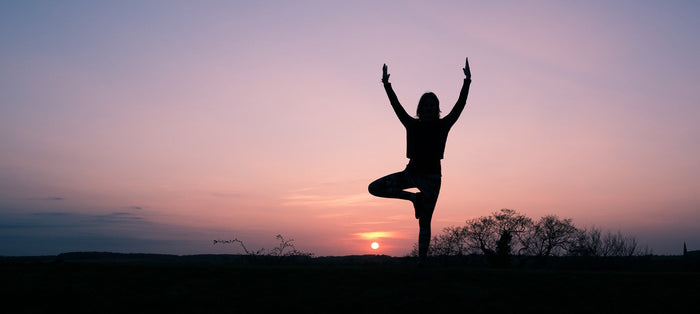
10. The tree pose is a balance exercise that even beginners can easily perform. In the gentler version, you place your foot on the ankle of your other leg or on your calf.
Professionals place their foot on the inside of their thigh. However, make sure you don't place it at knee level to protect it.
This asana has a positive effect on your balance and concentration, and also strengthens your entire musculature. It also represents grounding and connection with the earth.
11. Fish: Here you stretch backward as far as you can, opening your chest. This exercise opens the heart area and is particularly beneficial for the respiratory system.
Experienced yoga practitioners sometimes perform this exercise with their legs crossed in the lotus position. The more advanced you become, the better you will be able to stretch your rib cage.
12. Lotus Position: The lotus position promotes a stable and grounded posture – both physically and mentally. Admittedly, hardly anyone can achieve the full lotus position right away. For beginners, simply place one leg on top of the other.
The more flexible you become, the sooner you can try the full lotus position. Be sure to listen to your body. If it hurts, stop the exercise. The lotus position isn't mandatory – not even for advanced practitioners.

13. Warrior . The Warrior pose is a challenging standing exercise, but also suitable for beginners. One leg is bent at a 90-degree angle, while the other is extended far back. In Warrior 1, you simultaneously extend your arms straight up overhead to the sides.
This asana stretches the upper body, strengthens the leg muscles and improves balance.
14. Child 's Pose. In Child's Pose, bend forward from a kneeling position so that your forehead touches the floor in front of your knees. This exercise is very relaxing – at the same time, you stretch your back, neck, and shoulders. It is also ideal for beginners.
15. Crow. Okay, finally, a yoga pose that's a bit more challenging for beginners: The crow pose requires balance and arm strength. Just try it and see if you can do it. If not, try again another time. This asana strengthens your arms and improves your inner and outer balance.
Professionals balance effortlessly in the air. But with a little practice, even beginners can do it.
What's the best way to progress from beginner to advanced level?
Ideally, you should practice yoga under the guidance of a teacher who can correct your form. This way, you learn the exercises from the ground up without developing bad habits. However, always listen to your body and acknowledge its limits. Advanced practitioners can be recognized by their ability to train in harmony with their breath.
Tip for beginners: Hold each pose for about five to ten breaths. You can learn more about breathing techniques in yoga in our article: Deep in and out: 3 breathing techniques for more stamina in everyday life.

Focus on practicing each pose as mindfully and precisely as possible. If you enjoy deep stretches and challenging asanas, approach them slowly and have a professional demonstrate the poses beforehand.
As your yoga practice progresses, you will deepen your understanding of the learned poses and work on their correct execution. This is how you gradually become a yoga expert. Under professional guidance, you will continue to learn new things about yourself and the individual exercises, even after years of practice.
How to recognize when you've progressed
When you become advanced also depends on your goals: If you see yoga as a physical challenge, you may strive to regularly learn new exercises and will eventually master even the most difficult ones.
By the way: Even as an advanced yogi, you don't necessarily have to be excessively flexible.
However, if you are more interested in the spiritual component and the balance between body and mind, you should focus on the regular, mindful execution of simpler poses.
Whether beginner or advanced: that's what matters.
Yoga is more than just a sport. Therefore, the classification between beginners and advanced students is based on different criteria than in competitive sports:
-
Yoga is a physical and spiritual practice in which the correct execution of the poses is at least as important as controlled breathing.
-
The more advanced you become, the more precisely you listen to your body and the more you benefit from the individual asanas.
-
There is no objective distinction between beginners and advanced practitioners in yoga. Whether you are particularly flexible or can perform difficult poses is not a measure of your skill level. What is more important is daily or regular practice – ideally under instruction.
-
The sun salutation is one of the best-known yoga exercises. It's a great warm-up exercise because it works the whole body.
-
Always listen to your body during each yoga pose. Stop if it hurts, and feel free to use props for deep stretches – because yoga is not a competition.
-
Remember Yogi Krishnamacharya's quote (remember: anyone who can breathe can practice yoga.) and make sure to breathe calmly and evenly during each asana.

Yoga is primarily about the mindful execution of individual exercises and conscious breathing – and less about mastering the most complicated exercises that take your breath away.
Because breath – also called prana in yoga – should always flow during asanas. Whether you're doing gentle beginner exercises or gradually venturing into more challenging asanas, your breath is synonymous with your life energy.
Through regular practice, yoga will become a part of your life. Simply adapt your yoga poses to your physical condition, recognize your limits, and breathe consciously – you will soon feel the benefits of your yoga practice.
Deine Reise geht weiter...
WEITER LESEN
ALLE LESEN Yoga
Yoga
Breathwork: How just a few minutes of conscious breathing a day can change your life
The hype surrounding breathwork Breathing exercises (or 'breathwork') are all the rage. Working with your own breath is so simple, yet it's one of the most effective tools for combating stress. When you talk to wellness experts about relaxation, you inevitably come across breathwork. For example, breathwork teacher and freediver...
Read Now
 Road
Road
Franzisca's path to resilience through cold water therapy and breathing exercises
Introduction In our latest episode of Road to Calm, we had the honor of interviewing Franzisca Gartenmann, co-founder of Keen Wellbeing. She shares her personal journey through burnout and trauma to a fulfilling life as an entrepreneur. 🌟 Franzisca talks about the benefits of cold water therapy, sauna, and breathing...
Read Now
 Road
Road
A journey through Katonah Yoga and personal growth
A journey through Katonah Yoga and personal growth In today's episode of the "Road to Calm Podcast," we speak with Aylin Karadayi, an inspiring Katonah Yoga teacher, former nutritionist, and experienced entrepreneur. She recently opened her latest project, the Yoga & Wellbeing Studio VVOO, in Zurich. Aylin shares her profound...
Read Now
 Yoga
Yoga
15-Minute Yoga Challenge
15-Minute Yoga Challenge – Find inner balance in one month Most of us try to be just as productive and active throughout the winter as we are in the summer. If we don't manage this, we quickly start berating ourselves, especially after the first few weeks of the new year,...
Read Now
#luviyofamily
We are social 💗
Follow us @luviyo and join our family!
Loved by Peter and many more...