
MOST READ
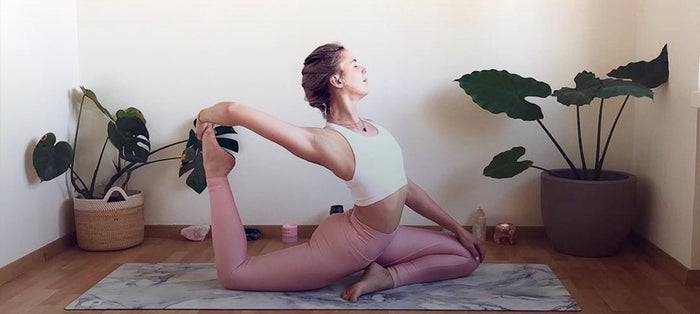
Did you know that the word yoga comes from Sanskrit and means to harness or to yoke? Both are words that fit well with our current crisis, in which we are all under some kind of tension.
And the thought of spending your entire day within your own four walls seems to fit the term "harnessing up." But don't worry, despite its etymology, yoga doesn't actually increase your current stress levels.
 It's more than just a yoga class; it's a path to self-discovery and a wonderful way to find physical and mental peace. Of course, practicing yoga in a relaxed group with your favorite yoga teacher works perfectly every week. But unfortunately, the studios are closed. The good news: you can also practice yoga wonderfully at home.
There are just a few things you should keep in mind. We'll show you how to best integrate yoga workouts into your daily routine at home below.
Tip 1: The right place to practice yoga at home
If possible, reserve a quiet spot for your yoga practice. This could be, for example, a quiet, enclosed room or a sheltered spot in the garden. A beautiful view is also particularly beneficial.
Make sure there isn't too much hustle and bustle or activity outside. If you live on a busy street, avoid a view of the outside. Your yoga space should have a relaxed atmosphere – this includes a comfortable room temperature and good ventilation.
In any case, you should be as undisturbed as possible during your daily yoga practice. Therefore, doing exercises between the coffee table and the television while the children are playing behind you is not ideal.
Set up your space in the best possible way. Essential equipment includes a yoga mat , perhaps a meditation cushion, and other accessories such as straps and blocks . Decorate your little yoga corner to your liking.
You can also light incense or candles before you begin – turning your practice into a little ritual. Doing this before each session will immediately put you in the right mood, and your body and mind will know: Aha, now it's time for yoga.
Tip 2: The right time for your yoga workout
In principle, you can choose the time for your yoga exercises according to your preferences. However, the morning has some advantages: You can easily schedule your yoga session right after waking up and then go about your day as normal.
You will notice that it is good for you mentally and physically, and that you can start the day feeling relaxed and happy.
Furthermore, if you go to bed 15 minutes earlier in the evening, you won't even be stealing valuable sleep. Plus, you'll feel good for the rest of the day and won't stress yourself out thinking about your workout.
Yoga for night owls
If you're a night owl, you can of course reverse the situation and do your yoga exercises in the evening. The important thing is to set a fixed appointment with yourself and stick to it.
Therefore, set a time that best fits your daily routine and your family's rhythm, set a reminder if necessary, and stick to your plan.
One more tip: You should practice yoga on an empty stomach. In the morning, simply eat breakfast after your practice session. And in the evening, it's best not to eat anything for one and a half to two hours before your yoga exercises.
Tip 3: This is how long your yoga workout should last
The duration of your workout also depends on your preferences. The rule is: the greater your ambitions, the harder it will be to stick to your resolutions. If you can commit to practicing for an hour and a half every Wednesday, that's obviously great.
It's easier if you train for 15 minutes every morning from Monday to Friday, for example. This short time slot is almost always available – and will certainly present less resistance than if you were to schedule a whole hour for your workout.

Because here's the thing: even if you love yoga, your inner couch potato might not like practicing all alone. To give your motivation a boost, you could, for example, arrange to practice with friends online. Use video chats like Skype, Google Hangouts, Zoom, FaceTime, or WhatsApp's video calling feature and do something good for your bodies, even if you're apart.
Tip 4: The right exercises
Think about which exercises you'd like to do beforehand. There are countless programs available, from Kundalini yoga to particularly gentle yoga. For example, check out YouTube channels or research suitable DVDs.
Important: Take some time beforehand to look at, select, and sort the individual programs. This way, you can get started immediately as soon as you arrive on the mat at the agreed time.
Make sure the level of the exercises matches your experience. If you're just starting out with yoga, you should focus on beginner programs. Good channels and videos for beginners and advanced practitioners include:
You'll have the most fun if you like the teacher and also find their voice pleasant.
Extra tip: Make sure that all exercises are explained during the execution, so that you can copy them even without looking.
If you are already an advanced yogi, you can of course put together your own program from well-known yoga exercises.
If in doubt, it's best to choose exercises where you can't go too wrong. These could include, for example, the following:
Use the workout alone to listen even more closely to your body. Do you need something energizing, or are you in the mood for a calming series of exercises?
Tip 5: Make sure you relax
Ideally, end your yoga practice with a relaxing meditation. Most videos you find online end this way. If you're practicing without a video, you can record your own voice as an audio file or, alternatively, simply shift your awareness through your body and notice the effects of the previous exercises.
If you have enough time, you can also lie quietly for a few moments after each exercise and focus on the muscles relaxing in your body. This will make your yoga practice even more intense.

Tip 6: Ideal for beginners – online yoga with corrections
If you have only recently started practicing yoga, you probably still need corrections from a teacher.
That's why instructors walk around the studio during class, gently correcting individual students. This isn't so easy to do at home – even with detailed video instructions. So what can you do?
Currently, there are many new online yoga courses available where the instructors can see you via camera while you practice. This allows them to guide you and ensures you perform the exercises correctly at home.
Check with your yoga studio; they might offer such a course.
Tip 7: Stick with it
The easiest way to stick with it is to practice regularly – for example, for 15 minutes every morning before breakfast. Ideally, you should do this daily or at least five times a week.
If you can't manage several times a week due to time constraints, schedule at least one yoga session per week and stick to it religiously. Do you usually go to a yoga studio regularly? Great, then simply use your usual time for your session at home.
And if you spontaneously feel like doing an extra round outside of your regular schedule, do it in addition to your regular appointments. This way you'll get used to your workout and it will eventually become second nature, turning into a routine.
Bonus tip: If you don't feel like practicing, grit your teeth and get on the mat anyway. Take at least five minutes. The rest will come naturally. After all, every beginning is difficult.
Yoga at home – not just during a crisis

Practicing yoga at home is a wonderful complement to your regular group yoga class. Therefore, you should ideally continue your private yoga session – even when you can finally return to your usual yoga class.
You will then benefit more from the exercises in yoga class. Because at home you have learned to listen to your body and not just to the instructions of a teacher.
Some yoga practitioners find practicing alone even more enriching than a regular class at the studio. They experience the desired union of body and mind more intensely at home.
And you too will quickly benefit from practicing yoga at home. If you get into a regular routine, you'll soon feel less tense and be able to face the crisis with more composure.
...and don't forget your LUVIYO.
Deine Reise geht weiter...
WEITER LESEN
ALLE LESEN Yoga
Yoga
Breathwork: How just a few minutes of conscious breathing a day can change your life
The hype surrounding breathwork Breathing exercises (or 'breathwork') are all the rage. Working with your own breath is so simple, yet it's one of the most effective tools for combating stress. When you talk to wellness experts about relaxation, you inevitably come across breathwork. For example, breathwork teacher and freediver...
Read Now
 Road
Road
Franzisca's path to resilience through cold water therapy and breathing exercises
Introduction In our latest episode of Road to Calm, we had the honor of interviewing Franzisca Gartenmann, co-founder of Keen Wellbeing. She shares her personal journey through burnout and trauma to a fulfilling life as an entrepreneur. 🌟 Franzisca talks about the benefits of cold water therapy, sauna, and breathing...
Read Now
 Road
Road
A journey through Katonah Yoga and personal growth
A journey through Katonah Yoga and personal growth In today's episode of the "Road to Calm Podcast," we speak with Aylin Karadayi, an inspiring Katonah Yoga teacher, former nutritionist, and experienced entrepreneur. She recently opened her latest project, the Yoga & Wellbeing Studio VVOO, in Zurich. Aylin shares her profound...
Read Now
 Yoga
Yoga
15-Minute Yoga Challenge
15-Minute Yoga Challenge – Find inner balance in one month Most of us try to be just as productive and active throughout the winter as we are in the summer. If we don't manage this, we quickly start berating ourselves, especially after the first few weeks of the new year,...
Read Now
#luviyofamily
We are social 💗
Follow us @luviyo and join our family!
Loved by Peter and many more...