
MOST READ

To the Mondo all-in-one yoga mat>
Why the elephant is our spirit animal
Elephants have a very special meaning in Hindu-influenced India, the country of origin of yoga: The god Ganesha has an elephant's head and a human body.
Its large head symbolizes wisdom, while its often very full belly represents perfection. Hindu scriptures such as the Rig Veda attest that the elephant-headed deity has been venerated for more than 7,000 years.
The symbolic power of the elephant remains undiminished to this day – even outside of Hinduism. We have been captivated by the inner peace and extraordinary aura of this breathtaking animal and have chosen it as our animal soulmate.
You can find out why we chose this particular spirit animal in this article.
Simply elephantastic: These are the qualities we admire
The elephant possesses several distinctive characteristics and behaviors that make it unique as an individual. We often take many of these as role models. For some of these qualities, it is also revered in a spiritual context as a power animal and companion .
These unique characteristics are a testament to the fact that these gray giants fully embody the qualities of the ideal yogi. It is with good reason that we believe we can learn from them when it comes to inner peace and discipline. We particularly value the following traits in these wonderful animals.
Patience and wisdom: Don't rush into anything.
The elephant is quite rightly described as a gentle giant. It is extremely patient and not easily disturbed. While we humans often struggle to make decisions, these animal giants are able to develop strategies to protect themselves, for example, from unwanted visitors.
The lead cow is in charge of the herd: Where can suitable watering holes be found, how can the herd be protected from predators? Sometimes, the knowledge and experience of the matriarch can be a matter of life and death. Quite capable, isn't she?

Strength and power: Steadfast in will
Let's be honest: It's no surprise that the largest land animal is a real powerhouse. However, this trait isn't solely due to its physical strength. Its remarkable willpower is another defining characteristic. No wonder, then, that these gray giants can travel up to 80 km a day in search of food.
We should take a leaf out of the elephant's book when it comes to self-discipline: The lack of motivation that prevents us from rolling up our yoga mat on some days, or ringing cell phones that distract us from our rest time, often result in us neglecting our routine.
Phenomenal memory: Always has the right information at hand.
Everyday distractions often lead to our memory resembling that of a fish rather than an elephant. There's a lot of truth to the exemplary reputation of the gray giant. These proboscideans possess an exceptionally good memory – their brains weigh around 5 kilograms, so there's plenty of room.
Enviable – because in the hustle and bustle of everyday life and in times of constant information and sensory overload, it is often difficult for us to reliably keep everything in mind.
Strong social skills: commitment to the family
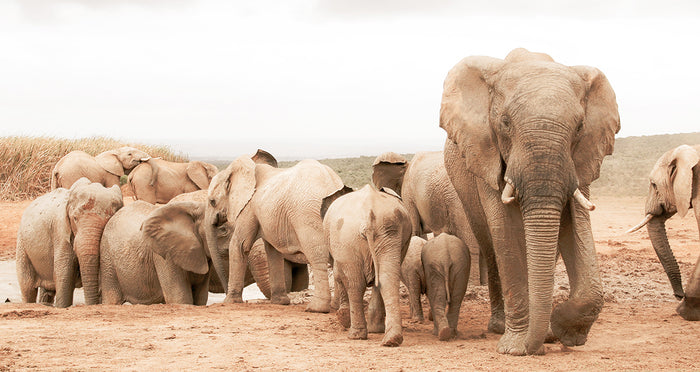
Speaking of reliability: it plays a significant role for our animal kindred spirits. Elephants possess social structures that we as modern humans should strive to emulate. Up to 15 animals live in herds and form a unique community with close family bonds .
An elephant rarely comes alone: The grey giants always stay in groups.
Newborns are cared for by the entire group. The mothers receive special support from the female elephants, who take on the role of midwives, offering protection and care to the baby elephant. They express their affection with their trunks.

Excellent communication skills, even over long distances
These four-legged creatures don't just communicate with trunk movements. In fact, they communicate through a wide variety of sounds – and via infrasound. Like whales, for example, they can converse with their fellow creatures over distances of several kilometers using infrasound .
Elephants are often chatty and communicate with other herd members. This ensures that the herd doesn't lose sight of each other, even when traveling long distances. This communicative awareness helps them better manage dangerous situations.
High sensitivity despite thick skin
The term "pachyderm," applied to these fascinating giant mammals, is indeed accurate – an elephant's skin is around 2 cm thick – but these animals are extremely sensitive . For example, they mourn deceased companions or, in some cases, even return to the place of their loved ones' deaths years later to remember them.
It has recently been proven that they can suffer from PTSD (Post-Traumatic Stress Disorder) after an encounter with poachers, for example. It's astonishing how similar these sensitive giants are to us when exposed to such extreme situations.
Vegetarian diet: pure sustainability
Prefer vegetarian: the giant infants feed exclusively on plants.
Although they consume up to 250,000 kilocalories daily, which is a hundred times the human requirement, and therefore seem to be eating constantly, they only take what they really need.
The large herbivores of the animal kingdom feed exclusively on plants and are extremely peaceful in their interactions with other animals. In their realm, these herbivores find everything they need, thus demonstrating their deep connection to Mother Nature.

White Marble All-In-One Yoga Mat
What does the elephant symbolize?
As you can see, the characteristics attributed to the elephant are practically predestined to make this noble animal a symbol. No wonder this extraordinary animal has found its way into so many different religions and cultures.
In Asia, the elephant plays a fundamental role: that of the world-bearer . There are countless creation myths according to which the earth rests on the back of one or more elephants.
Even outside of Asian creation myths, elephants play essential roles in various cultures and worldviews, as the following examples show.
What role does the elephant play in religion?
As mentioned at the beginning, the elephant has been revered in Hinduism for millennia as a representation of the god Ganesha. But not only there. In the much younger Buddhism, for example, which also originated in India, the elephant is considered sacred.
The Hindus' messenger of good fortune: Ganesha represents wisdom and good beginnings.
Even though Buddhism doesn't have the worship of gods in the classical sense, the elephant still possesses enormous symbolic power: According to legend, the birth of Buddha was prophesied by an elephant apparition. It's perfectly understandable, then, that devout Buddhists practically worship elephants, isn't it?
In Christianity, the elephant is used as a symbol in various metaphorical representations of the Bible. Here, it sometimes embodies the wisdom and foresight of God , and at other times it is assigned a concrete balancing role.
For example, on Noah's Ark, he ensures that the ship, which has become unbalanced, is righted again so that the animal passengers can ultimately reach their destination safely and continue to preserve the species.
A life in harmony and a soul filled with strength: The elephant seems to have found its inner center, which we seek when we retreat to our quiet corner and turn inward.
In the elephant, we have found a loyal companion.
The elephant is an extraordinary spirit animal. Firstly, its nature is more similar to ours than we imagine. Secondly, it perfectly represents the qualities we strive for when, accompanied by soothing sounds and fragrant candles, we embark on a quest to find our inner peace.
Wisdom, perfection, strength – like countless others, we join the ranks of those who understand these aspects as values. We invite you to do the same: Follow the elephant's example .

Deine Reise geht weiter...
WEITER LESEN
ALLE LESEN Yoga
Yoga
Breathwork: How just a few minutes of conscious breathing a day can change your life
The hype surrounding breathwork Breathing exercises (or 'breathwork') are all the rage. Working with your own breath is so simple, yet it's one of the most effective tools for combating stress. When you talk to wellness experts about relaxation, you inevitably come across breathwork. For example, breathwork teacher and freediver...
Read Now
 Road
Road
Franzisca's path to resilience through cold water therapy and breathing exercises
Introduction In our latest episode of Road to Calm, we had the honor of interviewing Franzisca Gartenmann, co-founder of Keen Wellbeing. She shares her personal journey through burnout and trauma to a fulfilling life as an entrepreneur. 🌟 Franzisca talks about the benefits of cold water therapy, sauna, and breathing...
Read Now
 Road
Road
A journey through Katonah Yoga and personal growth
A journey through Katonah Yoga and personal growth In today's episode of the "Road to Calm Podcast," we speak with Aylin Karadayi, an inspiring Katonah Yoga teacher, former nutritionist, and experienced entrepreneur. She recently opened her latest project, the Yoga & Wellbeing Studio VVOO, in Zurich. Aylin shares her profound...
Read Now
 Yoga
Yoga
15-Minute Yoga Challenge
15-Minute Yoga Challenge – Find inner balance in one month Most of us try to be just as productive and active throughout the winter as we are in the summer. If we don't manage this, we quickly start berating ourselves, especially after the first few weeks of the new year,...
Read Now
#luviyofamily
We are social 💗
Follow us @luviyo and join our family!
Loved by Peter and many more...