
MOST READ
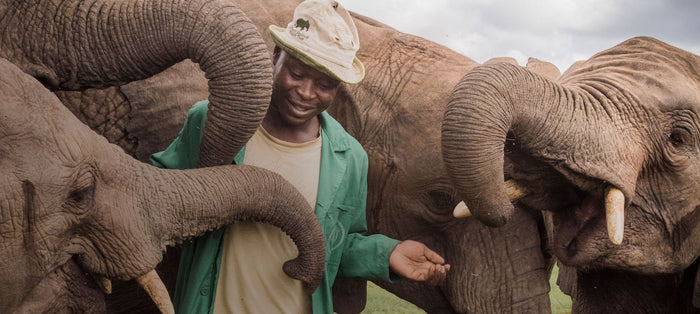
Over the past 10 years, the number of African forest elephants has declined by 60 percent. Poaching and the exploitation of nature by humans are the cause. We must act now, otherwise these magnificent animals could become extinct in the wild within the next decade. A grim prognosis that we are determined to counteract. In this article, we offer insights into our collaboration with the Sheldrick Wildlife Trust and explain why protecting elephants in Africa is so vital.
Yoga and elephants – how do they actually fit together?
Yoga allows us to take a break from everyday stress and practice mindfulness. But not only mindful treatment of ourselves, but also of other inhabitants of our planet, forms the basis for a way of life in harmony with nature. Only in this way can we achieve a harmonious coexistence among all beings on Earth.
We at LUVIYO cannot and will not imagine a world without elephants, these gentle giants. That's why we've made it our mission to give elephants in Africa a voice. To raise awareness of the dramatic decline and threat to African elephants, we include their symbol in our logo. But that's not enough for us – we truly want to make a difference so that elephants are no longer considered an endangered species. Above all, we want to help the most vulnerable of these gray pachyderms: the baby elephants.
The story of Luna: An orphaned elephant
 Luna is an African savannah elephant. She was born a year ago in the Kenyan Masai Mara, a nature reserve within the Serengeti National Park. Luna's mother was Musara, an elegant female elephant with magnificent tusks.
 Young elephants like Luna learn every step and trunk movement from their mother. Their survival depends on their mother's milk, which is why the little ones never leave her side. Unfortunately, ivory hunters were after Musara's tusks and stalked the elephant cow until she was no longer under the protection of the herd.
Poachers act brutally, taking the white, curved teeth of elephants without regard for the lives of the wild animals they came for. The violent attack often ends in the animal's death. Luna also lost her mother in this tragic way.
Without milk, Luna grew weaker and weaker until the herd eventually moved on without her. The little elephant wandered around, completely exhausted and frightened, defenseless against wildcats and other predators. It was only a matter of time before Luna lost her fight for survival. Fortunately, national park rangers discovered the baby elephant, and Luna was rescued. At the elephant orphanage, she recovered from her physical and emotional ordeal and found a new home. Today, Luna celebrates her first birthday – safe and sound.
Luna's fate is sadly not an isolated case. African baby elephants are increasingly being found in the wild, having lost their mothers.
Why are there orphaned elephants at all?
Every year , more than 20,000 elephants die in Africa due to poaching . So-called ivory hunters are after the tusks of adult animals. Although the trade in elephant tusks has been banned in most countries since 1975 , the black market for the violently removed tusks is booming. Poachers even penetrate protected nature reserves to hunt elephants. In addition to hunting, drought, deforestation, and other human-wildlife conflicts are among the threats to these pachyderms and have led to their drastic decline in recent decades.

Unlike Asian elephants, both male and female African elephants can develop tusks. This is why many female elephants, especially in Africa, are hunted, often leaving behind a calf. Not all baby elephants are as lucky as Luna and are found in time. Often, any help comes too late for them.
How can elephants be protected?
To understand how serious the threat to African elephants is, one only needs to look at the numbers. In 1969, there were still approximately 1.3 million animals – today, only about 400,000 savanna and forest elephants inhabit our ancient continent. In 2016 alone, the elephant population declined by 8 percent.

To counteract this radical loss, conservation projects have been launched in the past. Local aid organizations are tirelessly fighting poaching. Whether with aircraft in the air, trained rangers and veterinarians on the ground, or elephant orphanages as sanctuaries for animals that could not survive alone in the wild – many dedicated helpers are working around the clock.
How you can help save baby elephants with your yoga mat

Because baby elephants are so helpless without their mothers, their protection is very important to us. Our contribution is a donation of ten percent of the profits we make from the sale of our yoga wear.
The Sheldrick Wildlife Trust funds its project exclusively through donations and sponsorships and relies on every bit of support. The funds raised are used, among other things, to pay for:
-
The goalkeepers' salaries
-
Supplementary food during droughts
-
Veterinary care and medication
-
Costs for rescue aircraft
-
The construction of stables
-
The purchase of small trucks and special vehicles for transport from Nairobi to Tsavo.
Furthermore, the Sheldrick Wildlife Trust organizes the construction of water boreholes to ensure a continuous supply of this precious resource, even during the dry season. It also supports the work of the Kenya Wildlife Service (KWS) rangers, because only where ivory poaching is effectively combated can orphaned elephants have a secure future.
With your LUVIYO yoga mat, you're not only doing something good for yourself, but also for the endangered African elephants, making the world a little better.
Deine Reise geht weiter...
WEITER LESEN
ALLE LESEN Yoga
Yoga
Breathwork: How just a few minutes of conscious breathing a day can change your life
The hype surrounding breathwork Breathing exercises (or 'breathwork') are all the rage. Working with your own breath is so simple, yet it's one of the most effective tools for combating stress. When you talk to wellness experts about relaxation, you inevitably come across breathwork. For example, breathwork teacher and freediver...
Read Now
 Road
Road
Franzisca's path to resilience through cold water therapy and breathing exercises
Introduction In our latest episode of Road to Calm, we had the honor of interviewing Franzisca Gartenmann, co-founder of Keen Wellbeing. She shares her personal journey through burnout and trauma to a fulfilling life as an entrepreneur. 🌟 Franzisca talks about the benefits of cold water therapy, sauna, and breathing...
Read Now
 Road
Road
A journey through Katonah Yoga and personal growth
A journey through Katonah Yoga and personal growth In today's episode of the "Road to Calm Podcast," we speak with Aylin Karadayi, an inspiring Katonah Yoga teacher, former nutritionist, and experienced entrepreneur. She recently opened her latest project, the Yoga & Wellbeing Studio VVOO, in Zurich. Aylin shares her profound...
Read Now
 Yoga
Yoga
15-Minute Yoga Challenge
15-Minute Yoga Challenge – Find inner balance in one month Most of us try to be just as productive and active throughout the winter as we are in the summer. If we don't manage this, we quickly start berating ourselves, especially after the first few weeks of the new year,...
Read Now
#luviyofamily
We are social 💗
Follow us @luviyo and join our family!
Loved by Peter and many more...